Scotch Brigade, The [aka The Banks of the Clyde]
| AKA | Her lad in the Scotch Brigade On the bank’s of the Clyde The soldier’s farewell The Scottish soldier The burning hills of Egypt The burning plains of Egypt A lad and his lassie |
| First Published | 1884 |
| Writer/composer | JF Mitchell | Roud | RN1784 |
| Music Hall Performers | Marie Le Blanc |
| Folk performances | Collected from the singing of: Wildman, Alf ; England : Bedfordshire : 1960s Armstrong, Mike Ireland : Co. Wexford : 1907 McD., A ;USA : Massachusetts : 1921 Tanner, Ada ; England : Oxfordshire : 1926 Curtis, Thomas (John Morris Wellington) USA : Michigan : 1949 Galusha, John ; USA : New York : 1940-1950 Livingstone, Dan ; Canada : Nova Scotia : 1951 Campsall, Sam ; Canada : Ontario : 1958 Hare, Mrs. Perley ; Canada : New Brunswick : 1958 Murphy, Tom ; Ireland : Co. Kerry : 1958 Rash, Billy ; England : Cambridgeshire : 1959 Attrill, George ; England : Sussex ; 1959 Odell, Ned ; Canada : Labrador ; 1960 Wildman, Alf ; England : Bedfordshire ; 1965 Hutchings, Mrs. Martha ; Canada : Newfoundland ; 1966 Finlay, T. ; Canada : Newfoundland ; 1968 Kendall, Gordon ; Canada : Newfoundland ; 1968 Ling, Geoff ; England : Suffolk ; 1970 Wheat, Maurice ; England : Derbyshire ; 1970 Wildman, Alf ; England : Bedfordshire ; 1970 Hinchliffe, Frank ; England : Yorkshire ; 1970 Belton, George ; England : West Sussex ; 1971 Scuffins, Tom England : Suffolk : Framlingham 1974 Curtis, W.H.; England : Lincolnshire ; 1974 Walker, W. ; England : Lincolnshire ; 1975 May, Reginald; England : Lincolnshire ; 1975 Hussey, Moll ; Canada : Newfoundland ; 1976 Adams, Harry ; England : Somerset ; 1976 Webb, Percy ; England : Suffolk ; 1975-1976 Stockwell, Fred ; England : Hampshire ; 1977 Glavine, Bridget Mary ; Canada : Newfoundland ; 1978 Thomas, Amby ; Canada : Nova Scotia : 1978 Howell, Margaret ; England : Suffolk : 1975-1978 Dowdy, Douglas ; England : Hampshire ; 1982 McManus, Rose ; N. Ireland : Co. Fermanagh ; 1983 Jones, Frank ; England : Birmingham ; 1984 Rowe, Cliff ; England : Somerset ; 1984 Pardon, Walter ; England : Norfolk ; 1985 Kelly, John ; Ireland : Co. Mayo ; 1995 Legg, Viv ; England : Cornwall :; c2006 Aldous, Manny England : Suffolk ; no date Wildman, A. ; England : Bedfordshire Scrobbie, Alexander ; USA : Illinois : no date Raven, Mrs. ; England : Essex : no date Swain, Jack ; Canada : Newfoundland ; no date Mrs. Maggie ; Canada : Newfoundland ; no date Wildman, A. England : Bedfordshire ; no date |
The Scotch Brigade
Words and Music JF Mitchell

On the Banks of the Clyde stood a lad with his lassie;
The lad's name was Geordie, the Lassie's was Jean
She flung her arms around him and cried  "Do not leave me!"
For Geordie was going to fight for the Queen.
She gave him a lock of her bright auburn tresses
She kissed him and pressed him once more to her heart
Till his eyes spoke the love which his heart could not utter
But the last word is spoken, they kiss and they part

Over the burning plains of Egypt, under a scorching sun!
He thought of the stories he'd have to tell
His love when the fight was won!
He treasured with care
That dear lock of hair,
For his own darling Jeanie he prayed
But his prayer was in vain, for she'll ne'er see again
Her lad in the Scotch brigade.

Tho' an ocean divided the lad front his lassie,
Tho' Geordie was forc'd far away o'er the foam,
His roof was the sky, and his bed was the desert,
But his heart with his Jeannie was always at home.
The morning that dawn'd on the famed day of battle
Found Geordie enacting a true hero's part ;
Till an enemy's bullet brought with it its billet,
And buried that dear lock of hair in his heart.

On the banks of the Clyde dwells a heart-broken mother ;
They told her of how the great victory was won
But the glory of England to her brought no comfort,
For glory to her meant the loss of her son.
But Jeannie is with her to comfort and shield her,
Together they weep and together they pray ;
And Jeannie her daughter will be while she lives,
For the sake of that laddie who died far away.
There are several traditional songs with the title The Banks of the Clyde, this one originated in the music halls and was originally called The Scotch Brigade. It and was written for Marie Le Blanc (whose brief biography appears below), by her husband JF Mitchell and was her signature song for many years. Le Blanc and her representatives, notably agent Hugh Didcot and the notorious self-proclaimed copyright lawyer, Harry Wall, fiercely defended her sole right to sing it in the Halls. That said, a deal was done in 1888 to allow the Moore and Burgess Minstrels to sing it too, but only in the concert halls – not the Music Halls where le Blanc maintained sole rights ..
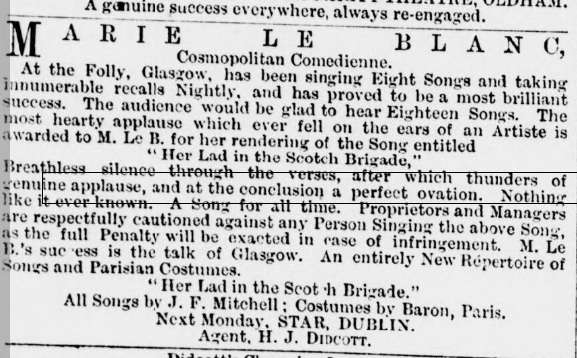
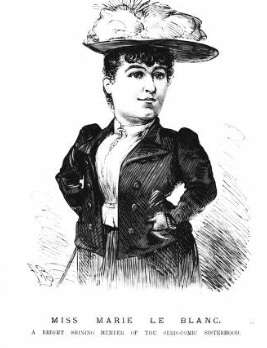
Marie Le Blanc (c1853-1924) was a successful female serio-comic performer of the 1880s and 90s. Her earliest performance recorded in The Era was in 1877 and she retired at the turn of the century. She was married to her main song-writer, JF Mitchell until his early death aged 35 in 1888. Le Blanc toured extensively throughout Britain and Ireland, visiting America in 1898 where she headlined at Tony Pastor’s Theatre.
She died whilst undergoing an operation for cancer, aged 71, in 1924.
Returning to the song itself, it was published as sheet music by Charles Sheard in 1884, and republished by Felix McGlennon in 1903. The 1884 sheet music does not appear in the catalogues of either the British Library or the Bodleian, but luckily Sheard published an arrangement for banjo in Sheard’s Vocal and Instrumental Banjo Album Book 1 (c1892) and I have used that as my source of the lyrics and melody (for now).
The song is probably referring to The Scots (or Scotch) Brigade, the 94th Regiment of Foot, an army regiment with a complex history. In 1882 members of the Brigade were involved in military action in support of the Khedive (or viceroy) of Egypt. Their success meant that Egypt effectively became part of the British Empire.
The song appeared regularly in print until at least the 1920s, both in unofficial publications like songsters and song sheets and in more official collections like:
- Songs of Soldiers (Melbourne, c1916)
- Sheard’s British war song album (London, c1919)
- The songs we know (New York, 1922)
Some other printed sources can be found in the Roud Indexes at the Vaughn Williams Memorial Library.
The song has proved extremely popular with traditional singers, and has been collected over 50 times all over the English speaking world – the Mainly Norfolk site explores some examples. One version, collected from the singing of Alf Wildman, mixes verses from the Music Hall song with verses taken from A sailor cut down (RN2), but as far as I can tell that is limited to the one example – as far as I can see all the other variants stick fairly closely to Le Blanc’s original.
Here’s a version by Mrs Perley Hare of New Brunswick, Canada. There is a break where she forgets the words and starts again. My very approximate reading suggests the singer’s melody is very similar to that on the sheet music.
Sources:
- Entries in the Roud Indexes at the Vaughn Williams Memorial Library: https://archives.vwml.org/search/all:single[folksong-broadside-books]/0_50/all/score_desc/extended-roudNo_tr%3A1784
- Ballad Index
- Mudcat Thread
- Mainly Norfolk
- Kilgarrif Sing Us
- Lyrics and Sheet Music : Sheard’s Vocal and Instrumental Banjo Album Book 1 (c1892)
- Marie Le Blanc image: London and Provincial Entr’acte – 27 December 1890
- New York Clipper from Archive.com
- National Army Museum: 94th Regiment of Foot